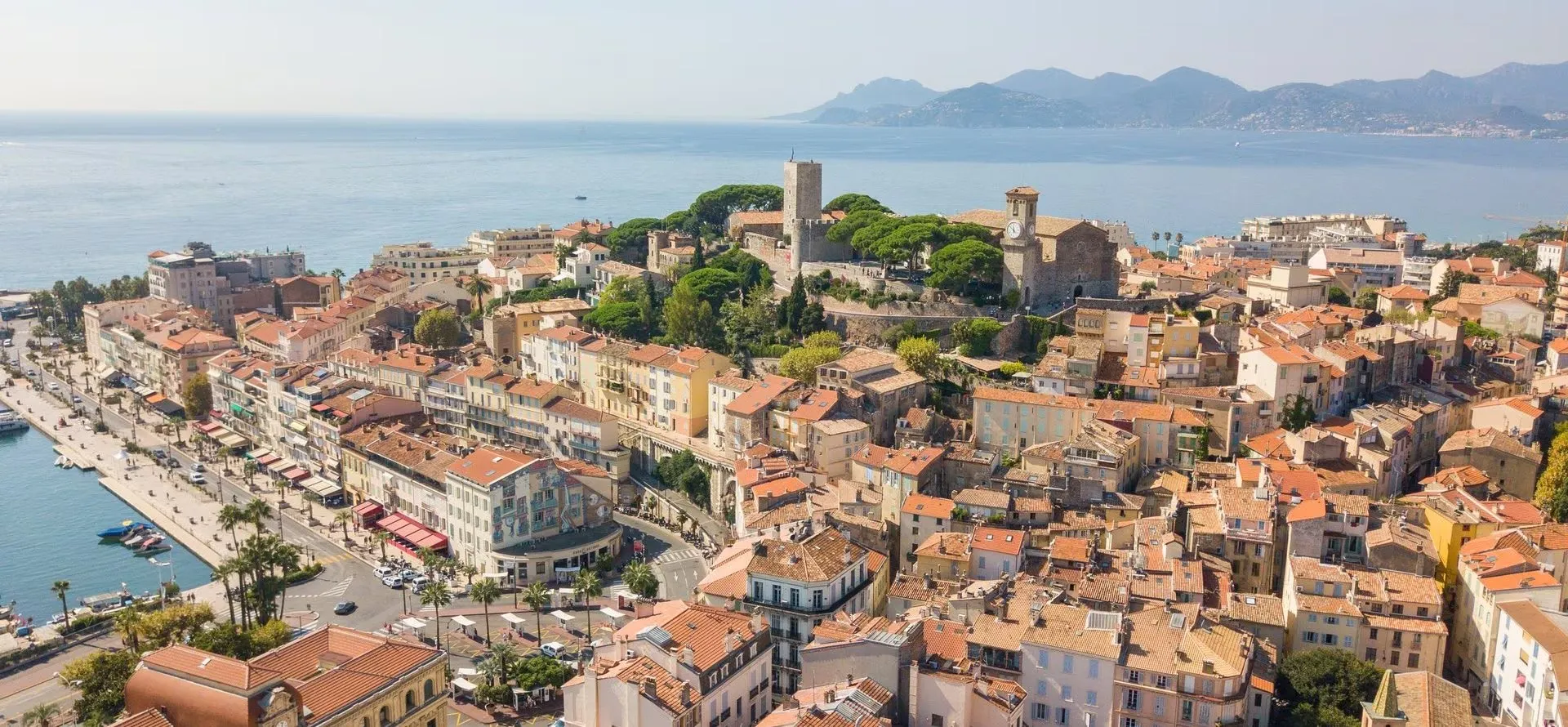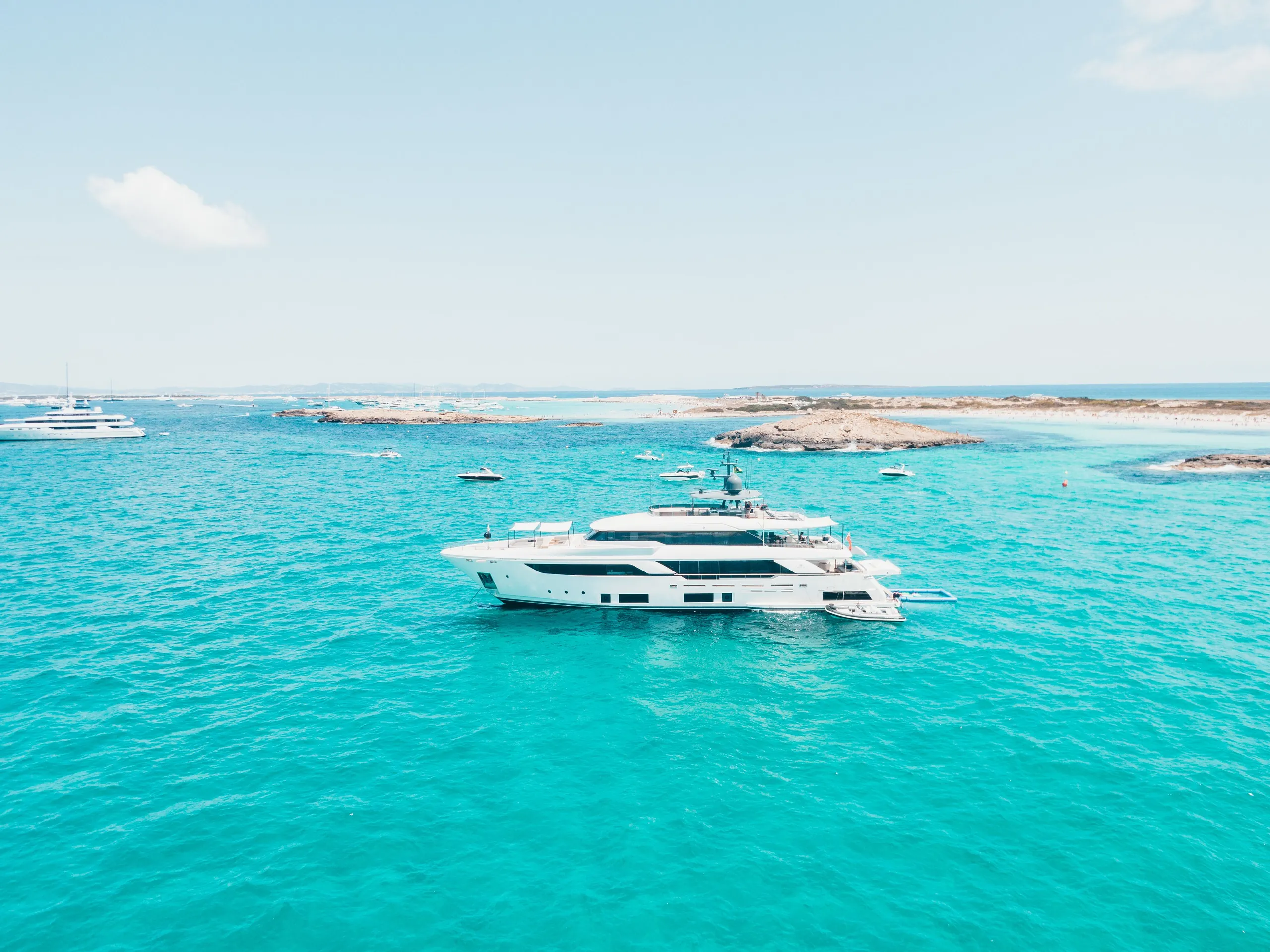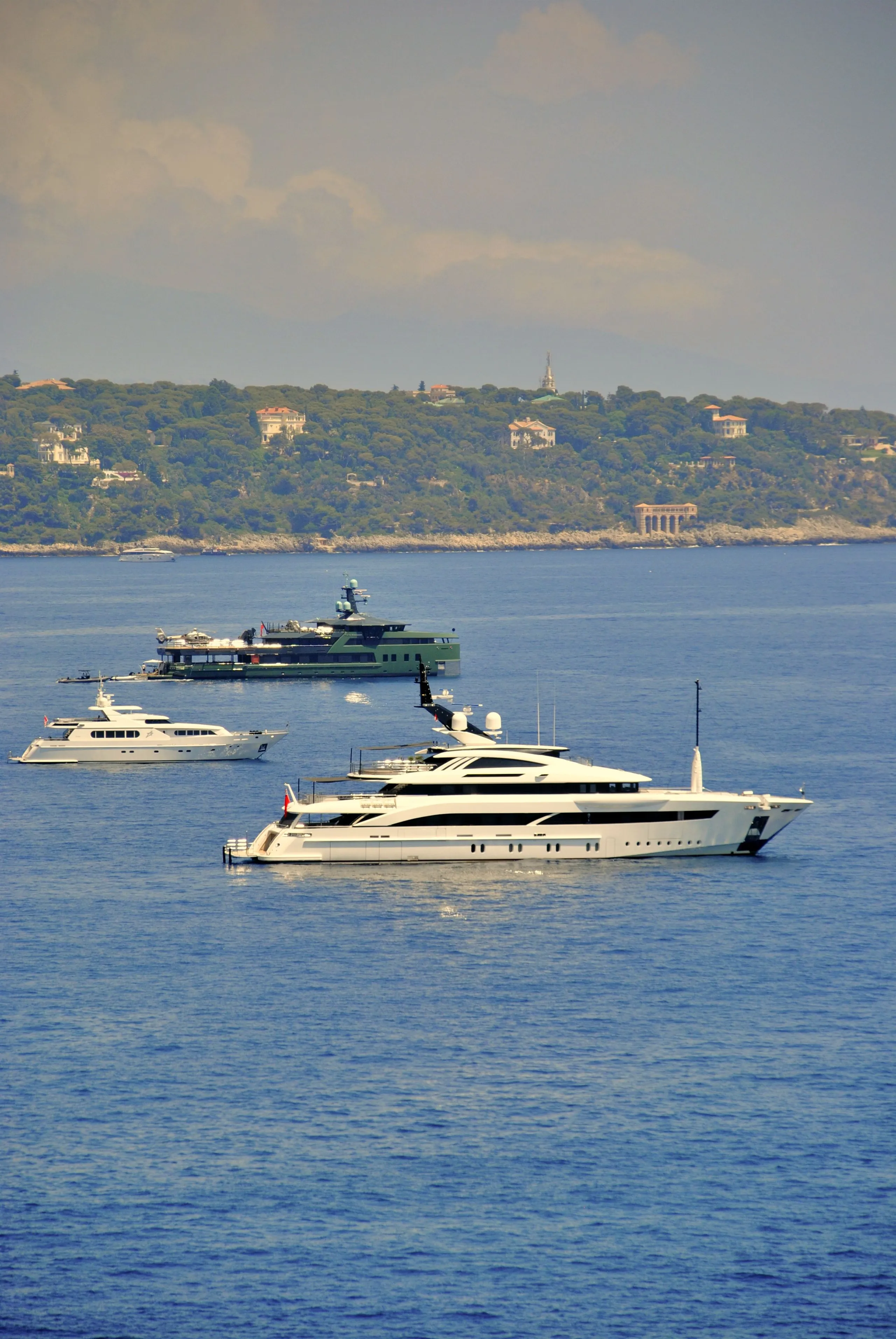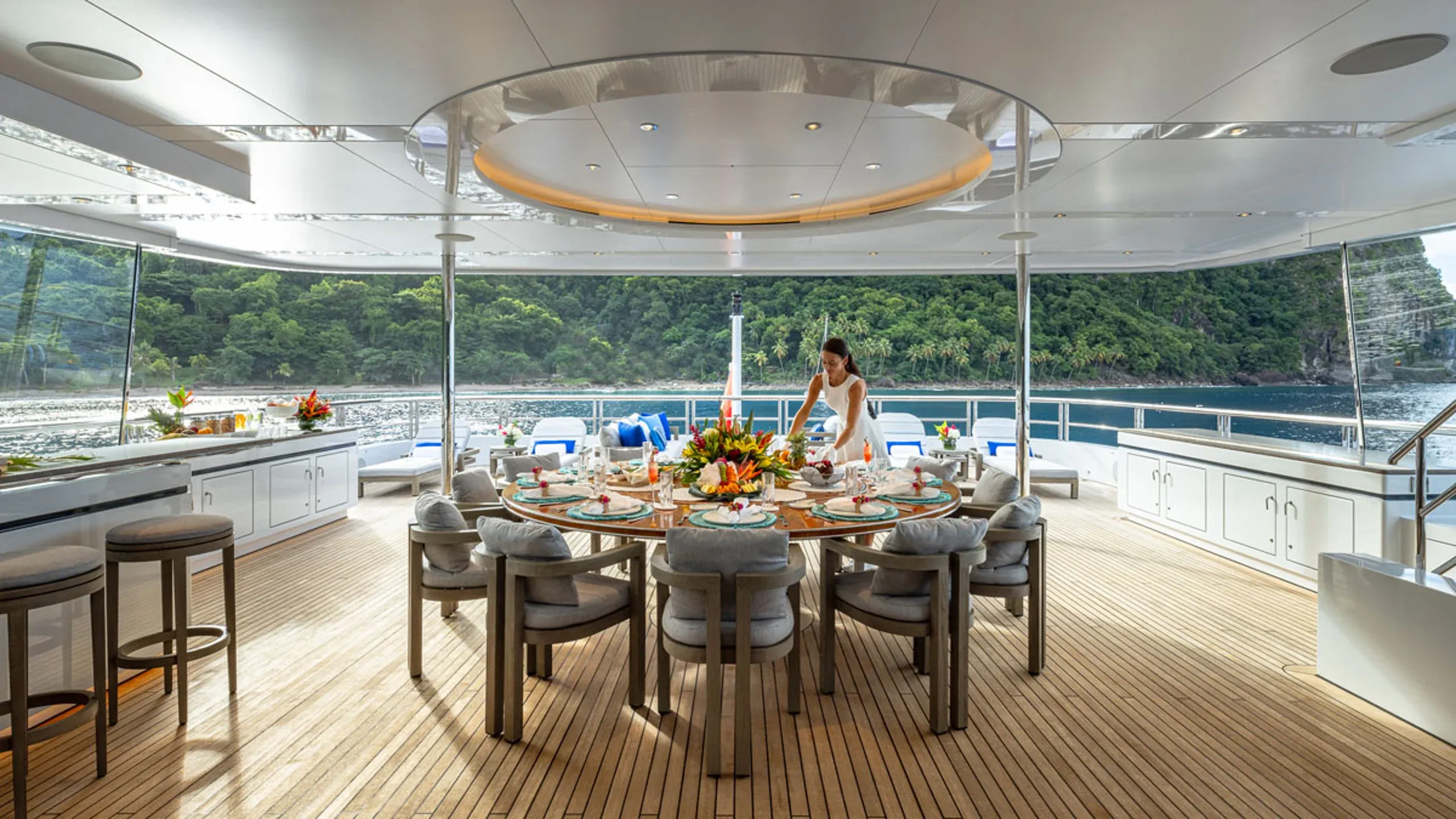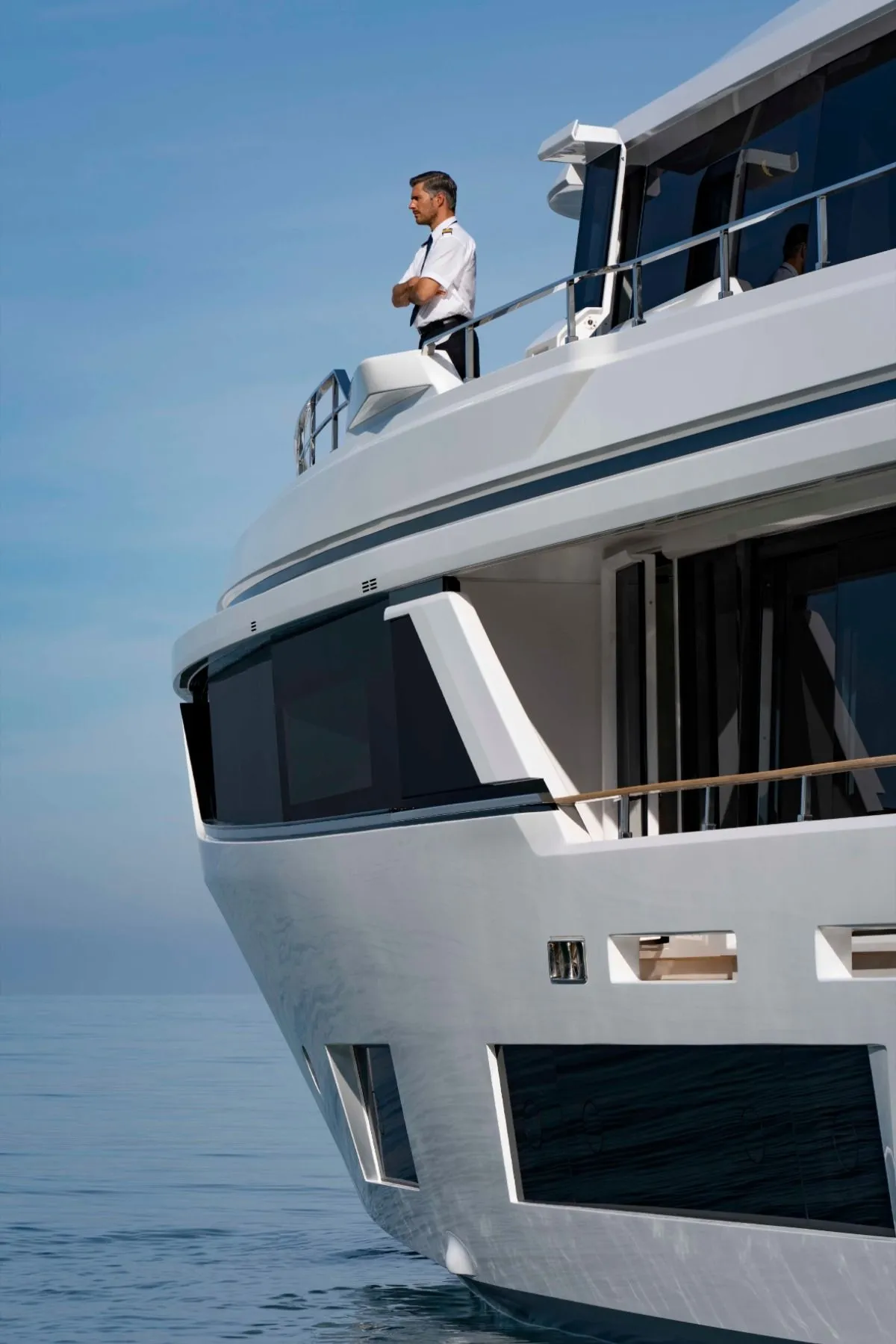
A crew is not a cost added to the holiday; on most charters the crew is the holiday. The hull, the tender, the deck space, the cabins: these are the stage. The people who run them are the production. Get the distinction right at the outset and the rest of the planning, including the comparison with a bareboat week, falls into place. Get it wrong and you find yourself doing the dishes off Porto Cervo while the season's best anchorage drifts past unused.
Both formats are legitimate. Both have a place. What separates them is not really price, though price differs, but the kind of week you are buying and how much of it you intend to run yourself.
What each format actually means
A crewed charter is a yacht delivered with her professional crew. You arrive, you are met, you are looked after, and you leave. The yacht is provisioned to your preferences, the itinerary is shaped around what you want each morning, and the operational weight of running a vessel at sea sits entirely with people who do it for a living. This is the standard model across the Mediterranean fleet from roughly twenty metres upward, and it is what most principals mean when they speak of chartering. It is the heart of any yacht charter worth the name.
A bareboat charter is the yacht alone. No captain, no chef, no stewardess. You take possession of the vessel, sign for her condition, and you are the skipper for the week. You plan the passages, you handle the lines, you cook, you clean, you anchor, and you carry the responsibility for the safety of everyone aboard. Bareboat is a sailing or motoring holiday in the truest sense, and for the right party it is one of the most rewarding ways to be on the water. It is also, unambiguously, work.
There is a middle path worth naming. A skippered charter is a bareboat yacht with a professional captain hired alongside her, sometimes a captain and a cook. It is common on monohulls and catamarans in the thirty-five to fifty foot range, and it lets a less experienced party keep the informality of a small yacht while putting the navigation and the anchoring in trained hands.
What a crew actually does, and why it changes the week
The word crew flattens four quite different jobs into one. Understanding them is the fastest way to understand what you are paying for.
- The captain runs the yacht and carries legal responsibility for her and everyone aboard. Beyond seamanship, a good captain is your local fixer: he knows which berth in Saint-Tropez to call for, when the meltemi will make the Cyclades uncomfortable, which Sardinian cove is sheltered from a forecast swell, and how to get a dinner table at Club 55 on Pampelonne in August when it is, by every public account, full. That last competence is worth more than most principals expect.
- The chef turns provisioning into something closer to a private restaurant. On a well-run charter the food is built around the guests' tastes after a pre-charter preference sheet, and the difference between a deckhand reheating supper and a trained chef plating lunch at anchor is the difference between a boat trip and a holiday.
- The deck crew handle the tenders, the water toys, the lines, the anchoring and the endless quiet maintenance that keeps a yacht presentable. They are also the reason you can be in the water within minutes of arriving at a bay rather than spending forty fraught minutes setting an anchor yourself.
- The interior crew, the stewardesses, manage the cabins, the service, the laundry and the rhythm of the day so that the yacht resets itself overnight and you wake to it as though the previous day never happened.
The cumulative effect is that on a crewed week your only decision each morning is what you feel like doing. That is the product. It is why the comparison with bareboat is rarely a like-for-like one.
When bareboat makes sense, and what it asks of you
Bareboat is the right call when the sailing itself is the point. A competent sailor with a capable crew of friends, cruising the Ionian or the Saronic in settled summer weather, can have a magnificent and genuinely affordable week that no crewed charter would replicate, precisely because the self-reliance is the pleasure.
It is not, however, available on demand. A reputable charter company will ask for evidence before they hand over a yacht, and the requirements vary by cruising ground and by the company's own underwriting:
- Certification. In most Mediterranean waters the skipper is expected to hold a recognised qualification. The International Certificate of Competence is the common reference point in Europe, often paired with the Short Range Certificate for VHF radio. Croatia, in particular, enforces this strictly and will turn away a skipper without the correct paperwork at check-in.
- A sailing résumé. Many companies ask for a written log of recent experience, and some require a second competent crew member named on the contract.
- A security deposit. Bareboat carries a refundable deposit against damage that can run to several thousand euros, often reduced by an optional damage waiver paid up front.
- A check-out and check-in. You inspect and sign for the yacht's condition on departure and again on return, and you are accountable for everything in between, including a grounding or a dragged anchor at three in the morning.
The honest filter is this: if any part of that list reads as a chore rather than a familiar routine, you want a crew, or at least a skipper.
The cost picture, told straight
Headline prices mislead, because the two formats price differently.
A bareboat yacht is quoted as a single charter fee, to which you add fuel, the end-of-charter clean, marina fees as you go, and your own provisioning. There is no crew to feed, accommodate or tip. For a capable party this is genuinely the most economical way to spend a week afloat.
A crewed yacht of any size is typically quoted under the Mediterranean convention as a base fee plus an Advance Provisioning Allowance, customarily set around a third of the base fee, from which the captain runs all running costs: fuel, food and drink, berthing, port fees and incidentals, with the unspent balance returned at the end. A crew gratuity, conventionally in the region of five to fifteen per cent of the base fee, sits on top and is genuinely discretionary. We set out the mechanics in full in our note on what a charter costs, and the picture changes again as you move up in size, which we cover in superyacht charter versus yacht charter.
The point that matters: a crewed charter is not a bareboat charter with people added. It is a different product with a different cost structure, and comparing the two on the base fee alone tells you almost nothing useful.
The exceptions where they matter
There are exceptions, and we note them where they matter. Cruising grounds with anchoring restrictions reward a captain who knows the rules: La Maddalena archipelago off northern Sardinia is a protected national park where anchoring is regulated and certain zones require permits and prohibit anchoring outright, and a local captain navigates that without spoiling the day.
Timing is its own exception. A bareboat week during the Cannes Film Festival in mid-May, or near the Monaco Yacht Show in late September, collides with the busiest berthing of the year, and a captain's standing relationships are the difference between a berth and a long anchored night offshore.
And scale removes the choice. Above roughly twenty-four metres, bareboat effectively ceases to exist; the yacht requires professional crew as a matter of regulation and insurance, and the question becomes which crewed yacht, not whether to take one. If the appeal of self-reliance is real but the open-sea passages are not, a single relaxed day under a captain through a day charter often scratches the itch without committing a week to it.
How to decide
Strip the decision to one question and answer it honestly: do you want to run a yacht for a week, or do you want a week on a yacht that runs itself?
If handling the lines, planning the passage and cooking at anchor is the holiday you are after, and your party holds the certification and the experience to do it safely, bareboat is the better and cheaper week, and a skippered version is the sensible halfway house if confidence is the only thing missing. If, instead, you want every morning to begin with a decision no larger than where to swim, a crewed charter is not the indulgent option. It is the one that delivers the thing you actually came for. The crew, in the end, is what turns a yacht into the holiday rather than the project.