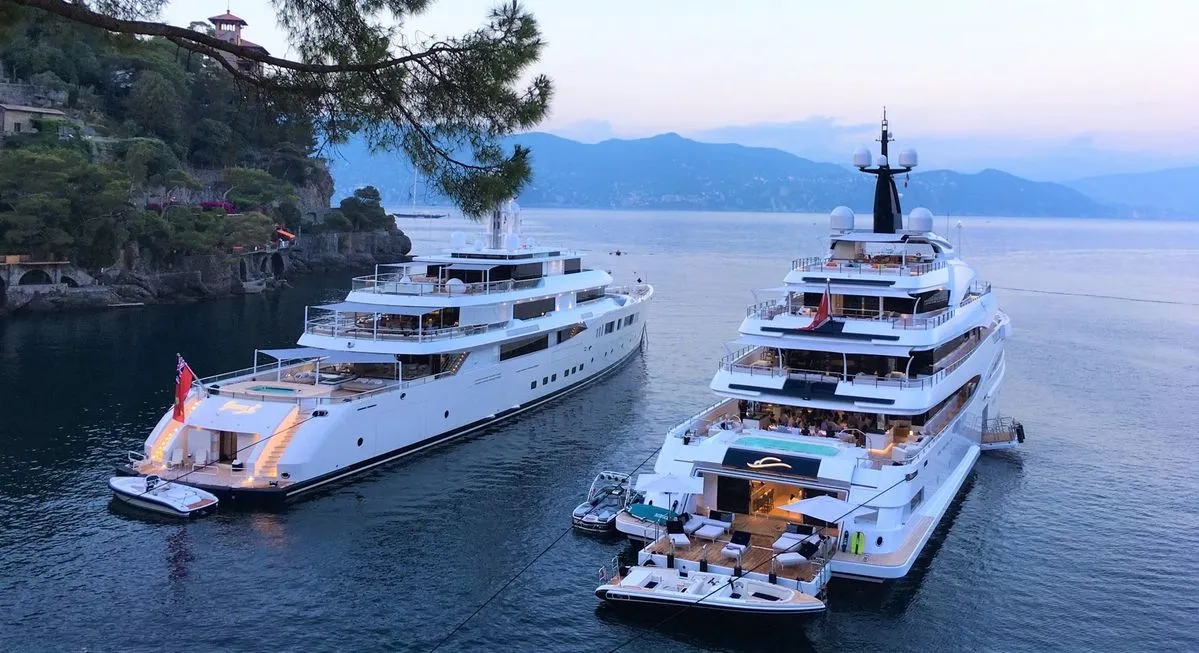
Private yacht charter in Montenegro
Montenegro's coastline is short, and the best of it folds inland. The Bay of Kotor runs deep into the mountains as a chain of connected bays, with Kotor and Perast on the water and churches, palaces and villages along the terraced shore; UNESCO has listed the region since 1979. A Montenegro yacht charter spends its first days in that sheltered water, then turns south to Budva and Sveti Stefan, or north to Dubrovnik.
The distances suit a yacht. Kotor is 8.5 nautical miles from Porto Montenegro at Tivat, Perast six miles from Kotor, and Dubrovnik about 36 miles from Tivat, so each stop can be taken at its own pace.
The Bay of Kotor and the coast
Kotor. The walled town sits at the head of the innermost bay, beneath fortifications that climb the mountain behind it. Many of its monuments were damaged in the 1979 earthquake and restored, largely with UNESCO's help. The walls are best climbed in the cool of the morning.
Perast and its islets. Perast faces St George and Our Lady of the Rocks, an artificial island built up from rocks and sunken ships, with a church renovated in 1722. Anchoring room off the town is limited, so the tender takes guests across.
The Luštica peninsula. Towards the open sea, the coves of Luštica are sheltered and clear, and suit a quiet night at anchor.
Budva and Sveti Stefan. On the open coast, Budva's old town is busy in summer, and a marina berth is the practical choice in high season, as safe anchoring room near the shore is limited. Sveti Stefan, 5.5 miles further on, is a small island joined to the mainland by a narrow tombolo, best seen from the water.
A week from Porto Montenegro
One route stays close: Kotor, then Perast, south to Budva, 21 miles from Perast, and Sveti Stefan, then back to the Luštica coves, 12 miles from Sveti Stefan, for a last night at anchor. At a sailing yacht's pace no leg takes more than half a day; a motor yacht covers most in an hour or two.
Another crosses the border, from Dubrovnik to the bay or the reverse. The yacht clears out of Croatia at Cavtat and into Montenegro at Portonovi, Zelenika, Porto Montenegro or Kotor, where the vignette, the Montenegrin sailing permit, is bought. Montenegro is outside the EU and the Schengen area, so passports are checked on both sides.
When to go
The season runs from May to October. June and September offer the most balanced conditions; July and August are the busiest months, and August fills the marinas. The summer wind is the maestral, a north-westerly that builds through the day and eases in the evening. The bora, a cold north-easterly that can arrive suddenly, is more likely in spring and autumn, and the jugo, a warm south-easterly, affects the open coast more than the bay, which stays sheltered when the wind is up outside. Perast holds the fašinada in July, when local boats carry stones out to Our Lady of the Rocks at sunset, and Kotor's summer carnival follows in August.
Marinas and arrival
Porto Montenegro at Tivat has about 450 berths, including one for yachts up to 250 metres, and Tivat Airport is about ten minutes away by road; Podgorica Airport is about two hours. Portonovi, at the entrance to the bay near Herceg Novi, takes superyachts and is a port of entry. Dubrovnik Airport is about an hour and a half from Tivat by road, border included. Diesel for yachts is sold free of VAT and excise duty at Porto Montenegro, Portonovi and Marina Bar. Montenegro is not in the EU, but the euro has been its only legal tender since 2002.
Yachts and what a week costs
Porto Montenegro is one of the Adriatic's superyacht home ports, and yachts based around Dubrovnik can include the bay in a week, which widens the choice for superyacht charter as well as for smaller yachts.
As a Mediterranean guide, a 20 to 30 metre motor yacht runs from around EUR 30,000 to EUR 80,000 a week before running costs, a 30 to 45 metre yacht from around EUR 80,000 to EUR 250,000, and yachts above 50 metres from around EUR 250,000, quoted individually. Sailing yachts usually sit below motor yachts of the same length. The Advance Provisioning Allowance, typically 25 to 35 percent of the base rate, covers fuel, food and port costs, and gratuity is customarily 5 to 15 percent. The applicable tax, which differs between Montenegrin and Croatian waters, is set out before anything is signed. What a yacht charter costs explains each line.
How a Montenegro charter is arranged
Montenegro works as a week on its own or as the southern end of a route through Croatia and the wider Adriatic. We shortlist the yachts that suit your group, plan the route around the wind and the border, and arrange the clearance when the itinerary crosses into Croatia.
Tell us your dates, the size of your group and what you have in mind, and we will come back with a shortlist. Start the conversation.